In brief
On June 16, 2026, Databricks launched CustomerLake, an "agentic" customer data platform (CDP) built inside its lakehouse, and handed the industry a new vocabulary: Infinity Campaigns, Golden Context, Profile Agents and Campaign Agents. This article explains what those terms mean, separates the architecture from the marketing, and sets out what buyers and vendors should do next.
- An agentic CDP changes the unit of marketing work. The campaign gives way to a continuous loop in which agents read live customer context, decide, act and learn, while humans set the goals and the guardrails.
- "Infinity Campaigns" is Databricks' name for that loop: always on, personalized to the individual, and reacting to signals in near real time instead of on a batch schedule.
- CustomerLake is early. It is in Private Preview, with general availability expected in late 2026 or early 2027. It covers identity, profiles, audiences, decisioning and activation, but not message delivery or client-side event collection.
- The real move is architectural and commercial. No data copy, governance inherited from Unity Catalog, and consumption pricing that is reported to carry no platform fee. Composable and reverse-ETL vendors feel it first; Gartner expects Snowflake and others to follow.
- Demand is running ahead of readiness. In Adobe's 2026 survey of 150 CDP users, 98% call the CDP essential for the agentic future, and AI agents jump from 12% to 66% as the top-ranked CDP capability within three years. Yet only about three in ten are very confident their warehouse can feed agents real-time context.
- The gating factor is readiness, not vendor choice: validated events, identity and consent on one profile, written guardrails, a measurement design and a portability plan. The buyers section gives the checklist.
What "agentic CDP" actually means
An agentic CDP is a customer data platform in which software agents, rather than marketer-built rules, are the primary operators. The agents read customer context, decide the next action for an individual, execute it through a channel, and update what they know, continuously, inside goals and guardrails that people set. That is CdpHub's working definition, and it is deliberately vendor-neutral, because four vendors published four different versions of the idea in the space of a few months.
| Vendor and source | What "agentic" means to them | Where the intelligence runs | Where the data lives |
|---|---|---|---|
| Databricks, "What is an Agentic CDP?" (June 17, 2026) | Three tests: it powers always-on 1:1 personalization through Infinity Campaigns, it is embedded in the data foundation, and agents are first-class operators from day one rather than a bolt-on chat box | Inside the lakehouse, next to the data and the models | In the lakehouse, with Lakehouse Federation reaching into Snowflake, BigQuery and object storage |
| Hightouch, "The next chapter: Agentic CDP" (June 15, 2026) | Agents that work in the background, investigate the data for hours, and present marketers with a ranked list of opportunities, each with a draft audience, message and brief | A long-running agent harness in Hightouch, drawing on Snowflake Cortex, Databricks Genie, Looker and MCP sources | Stays in whichever warehouse the customer runs; "composable context" rather than a copy |
| Twilio Segment, "A CDP is the best contextual data layer" (July 19, 2026) | The CDP as the contextual data layer that agents consult before acting: who is this person, what just happened, and what am I allowed to do | In whatever agents the enterprise builds or buys; the CDP supplies identity, consent and a short list of decision traits | In the CDP's live profile, mirrored to the warehouse on a schedule |
| Adobe, State of the CDP Report 2026 (September 30, 2026) | The CDP becomes the "control plane for AI": it determines what agents know, what they can act on, and how that context moves between systems | In the suite's agents (Experience Platform Agent Orchestrator) and in third-party agents the CDP feeds | In Real-Time CDP, aligned with the data warehouse |
The definitions disagree about geography and agree about substance. All four say the Golden Record is no longer enough. Databricks calls the replacement Golden Context: the customer's profile, plus what the business is trying to achieve right now, plus the history of every decision already made about that person and how they responded. Twilio reaches the same place from the other direction, arguing that agents need traits rather than tables, with consent stored on the same record so an assistant never emails someone who opted out. Adobe's survey respondents put it in priorities: unstructured data management (76%) and privacy and regulatory compliance (75%) top the list of capabilities they want next.
The disagreement about where intelligence should live is the whole commercial fight, and the rest of this article returns to it. For a buyer, the useful question is simpler than any vendor's definition. A chat interface over a segment builder is AI-assisted marketing. A system is agentic when it passes three tests:
- It originates work. It proposes or takes actions a marketer did not explicitly queue. Hightouch's own framing is blunt: for a decade the CDP executed ideas but never had one of its own.
- It closes the loop. Outcomes flow back and change the next decision without a person rebuilding the campaign.
- It runs under governance. Consent, eligibility, suppression, frequency and brand rules are enforced at decision time, not reviewed afterward.
One historical note: Databricks did not coin the term. GrowthLoop and Simon Data had been describing themselves as agentic composable CDPs for the better part of a year, and Hightouch published its manifesto the day before the Databricks keynote, as Martech Therapy noted at the time. What Databricks added was not the word but the ground it stands on.
Infinity Campaigns, explained
An Infinity Campaign is a campaign with no end date, no fixed path and no fixed audience. Databricks defines it as an autonomous, continuously compounding engagement loop that adapts its message, timing and channel as new context signals arrive. In its launch material the company breaks the idea into three "infinities":
- Infinite duration. Campaigns stop being one-off batches and become always-on, evergreen loops that keep running as long as the goal exists.
- Infinite journeys. Agents can route each customer down a path of their own, with creative and content varied per person rather than per segment.
- Infinite speed. The stated ambition is zero latency from customer signal to action, removing the weeks humans spend re-planning campaigns every time conditions change.
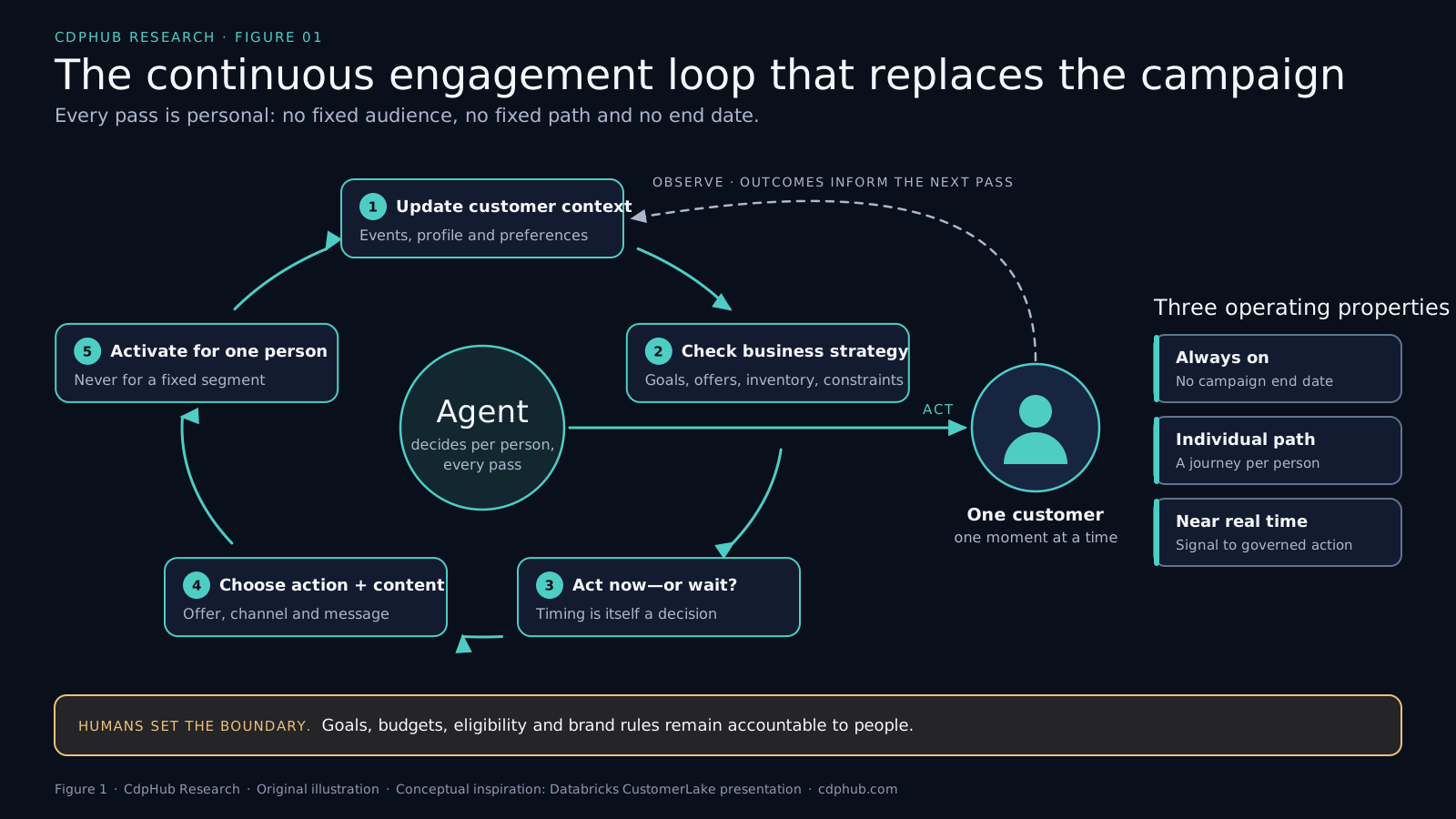
The loop itself has five moves, and it is worth naming them because every vendor's version has the same shape. The agent updates its picture of the customer with the latest data. It checks for changes in business strategy, such as a new offer, an inventory constraint or a revised goal. It decides whether to act now or wait. It evaluates the best action and the best content for this person. Then it activates for that individual only, and the outcome feeds the next pass. People sit outside the loop, not inside it: they set the goal, the budget, the eligibility rules and the brand constraints, and they review results.
Compare that with the workflow every marketing operations team knows. Define an objective, request data, build a segment, validate the audience, create a journey, launch to channels, measure, repeat. Databricks is right that in a complex enterprise this takes weeks or months, and that it assumes customers move through fixed paths when their intent, eligibility and channel preferences are changing constantly.
Databricks' own illustration is an airline. A traditional campaign for a frequent flyer uses demographics, transactions and engagement history to send a timely offer for the next booking. An Infinity Campaign for the same traveler notices that her flight is two hours late, that she is traveling with three children under ten, that the lounge has capacity tonight, and that she complained about a delay six months ago and nobody followed up. The right action is complimentary lounge access, not a booking email.
Two observations from a vendor-neutral seat. First, the loop is not new. Next-best-action decisioning has existed in Pega, in the Salesforce and Adobe suites, and in Hightouch AI Decisioning for years; what is new is that large language models can vary the content as well as the choice, and that the loop now runs where the data already lives. Second, the word "campaign" survives for good reasons. Budgets, approvals, brand calendars and legal review still exist. In practice an Infinity Campaign is a goal, a set of constraints and a decision policy, with agents choosing per person inside them. That framing matters for governance, and it is how the readiness checklist later in this article is built.
The four eras of the CDP
The customer data platform has moved closer to the data with every generation, and the agentic era is the first in which it stops moving because it has arrived. Databricks tells the story on two axes, data proximity and intelligence, and the framing is useful even if you discount the vendor's conclusion.
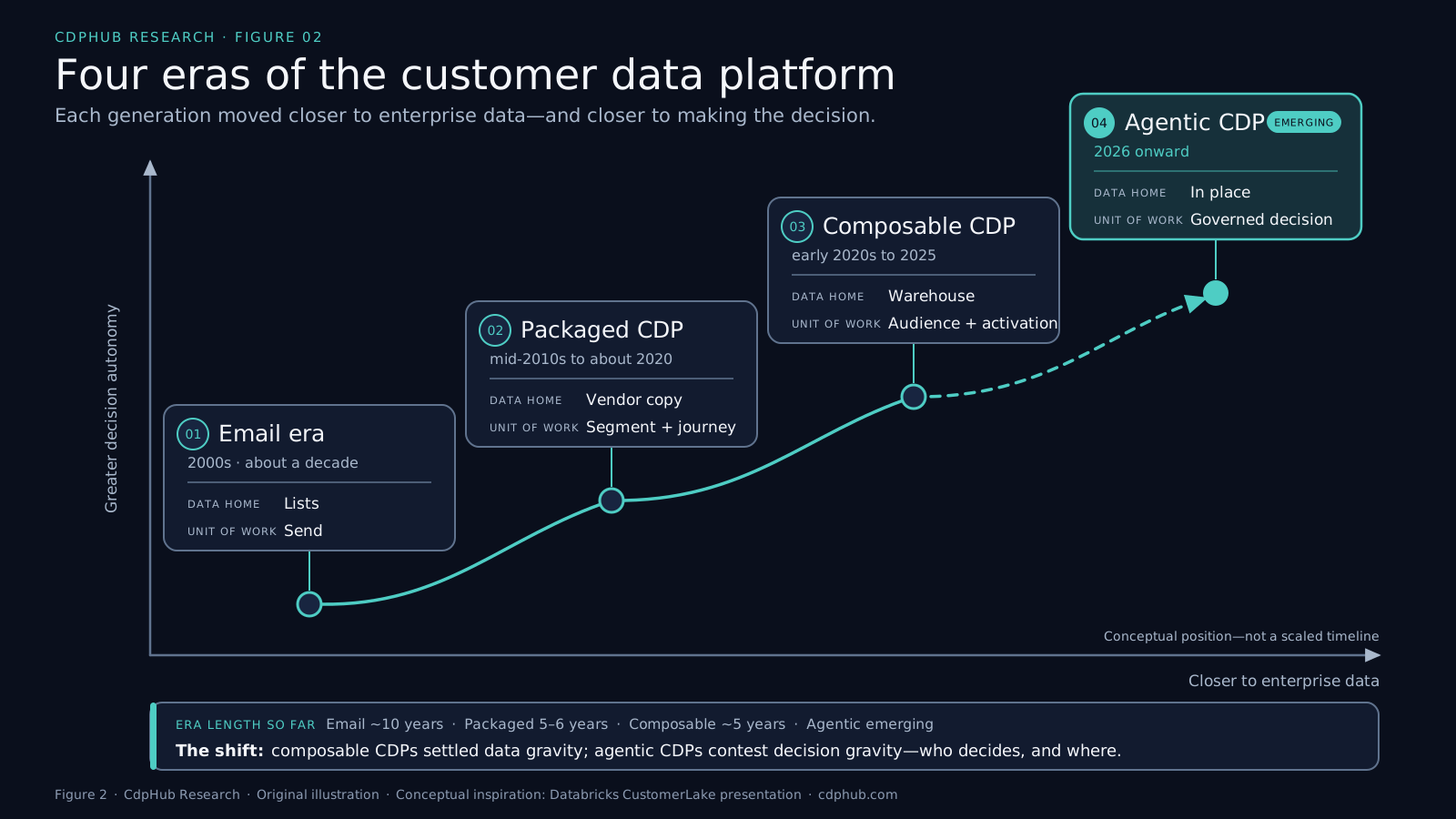
| Era | Rough span | Where the customer data lives | Unit of work | Who operates it |
|---|---|---|---|---|
| Email era | 2000s | Lists in the ESP; not really data at all | The send | Email marketer |
| Packaged CDP | Mid-2010s to about 2020 | A copy, in the vendor's proprietary store | Segment and journey | Marketing operations |
| Composable CDP | Early 2020s to 2025 | The warehouse or lakehouse; reverse ETL copies slices to each channel | Audience and sync | Marketing ops with data engineering |
| Agentic CDP | 2026 onward | The data platform itself, or a neutral layer reading it in place | Goal and policy; agents choose per person | Humans set goals; agents execute |
Three things stand out in the sequence. The first is that the composable era settled the question of data gravity. The warehouse won; even packaged vendors now mirror profiles to Snowflake, Databricks and BigQuery. Treasure AI's CDP.com argues the open question has become decision gravity: who controls where and how decisions are made on that data. CustomerLake is a bid to own the decisioning layer, not just storage.
The second is compression. Email held marketers for most of a decade and packaged CDPs ran the 2010s, but composable got roughly five years before agentic arrived behind it. Martech Therapy makes the point that each era now lasts less time than the one before, which should temper any vendor's claim to be the final resting place of the category.
The third is that "embedded" is a rebundling. The composable movement unbundled the packaged CDP into warehouse plus activation layer. A lakehouse that builds its own front door bundles it back together, under the data owner's roof rather than the application vendor's. One former ActionIQ employee, now at Snowflake, titled his reaction "Time to rebundle and repeat history", and that is a fair summary of where the architecture has landed.
Inside Databricks CustomerLake
CustomerLake is Databricks' first marketing product, announced at the Data + AI Summit on June 16, 2026, and available in Private Preview. It is led by people who built the previous two eras: Tasso Argyros, who founded ActionIQ, runs engineering; Justin DeBrabant and Michael Trapani, also from ActionIQ, lead product and go-to-market; Katy Yuan came from Census. Databricks did not buy a CDP. It hired the people who had built them and pointed them at data it already holds.
The architecture
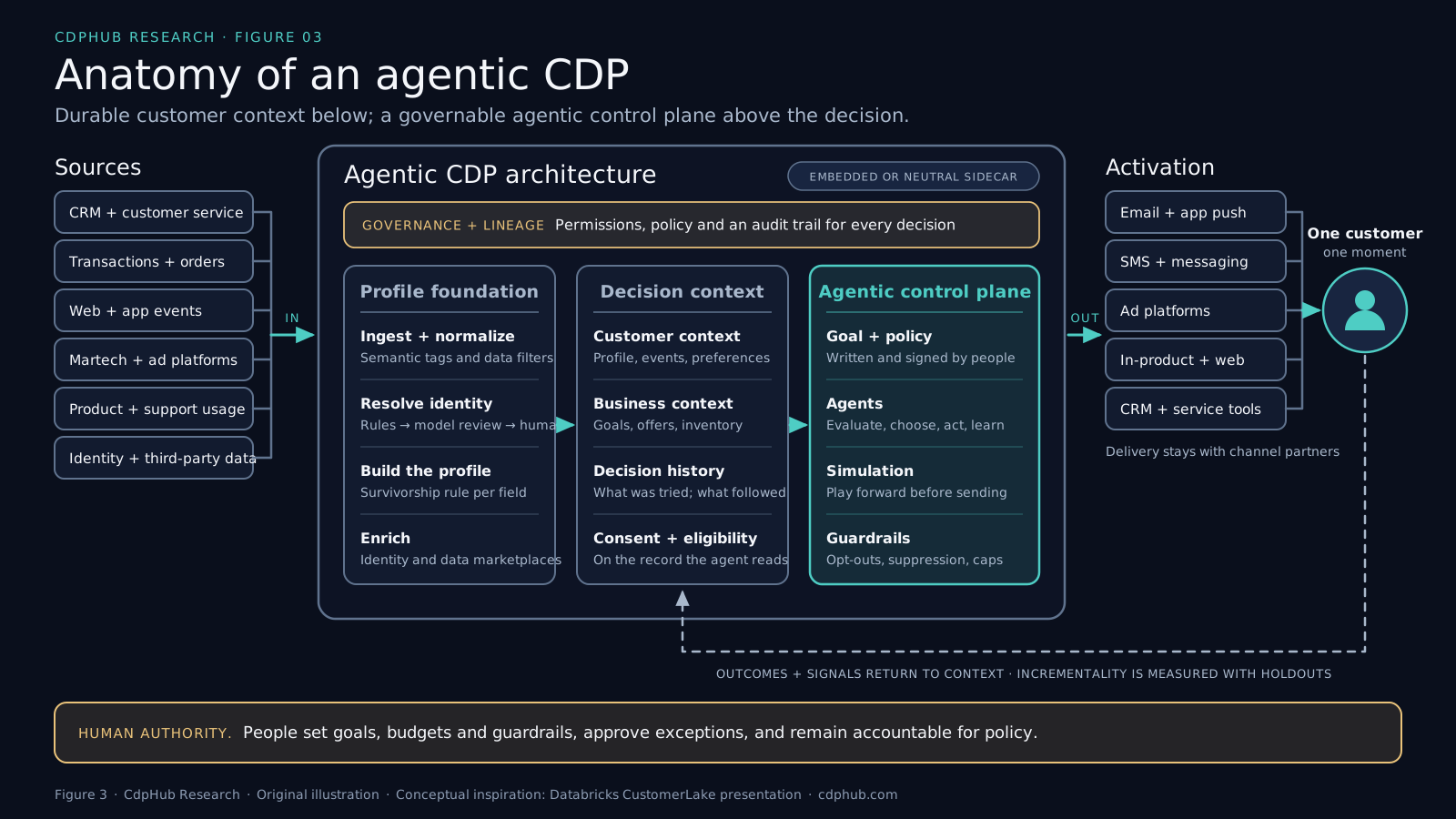
CustomerLake sits between ingestion and activation inside the lakehouse, governed by Unity Catalog. Lakeflow Connect brings in the martech stack, CRM, customer tables, transactions and policies, and behavioral events; Lakehouse Federation lets it query data that stays in Snowflake, BigQuery, object storage or operational databases. Two families of agents do the work:
- Profile Agents turn raw data into business-ready Customer 360 profiles: semantic tagging and normalization, industry data models, a data and identity marketplace, data evaluations that run as loops, and Agentic Identity Resolution (AIR), which combines deterministic rules, probabilistic matching and agent review.
- Campaign Agents build audiences, automate campaigns, personalize in real time, model customers, surface performance insights and hold the customer semantics marketers plan with. Genie, Databricks' natural-language interface, is the front door for both.
The output is what Databricks calls Infinity Campaigns, activated through native connectors and bi-directional reverse ETL to martech platforms, email and app tools, SMS, in-product surfaces and ad platforms. Delivery is deliberately left to partners.
What the preview actually shows
The launch presentation and demo screens are more informative than the blog post, because they show where the agents are placed in the workflow and where humans keep a hand on the wheel.
- Data prep. Genie prepares a new source, such as a ticketing resale customer file, by recommending semantic types (email, phone, full name, address) and data filters (nullify placeholder emails, phone placeholders, placeholder names and PO Box addresses), with fill rates and distinct counts per column. The data team accepts or rejects the recommendation.
- Identity resolution as tiers. Matching rules run in order: exact customer ID, then normalized email, then phone plus fuzzy name, then postal code plus fuzzy name, which is routed to review rather than matched automatically. Pairs no rule resolves fall to an LLM review, and the uncertain remainder to a human. Decisions feed back into agent training. When a new source arrives, Genie proposes rule changes.
- A gold customer table with survivorship. A canonical schema (first name, last name, primary email, primary phone, date of birth) maps every source into it, with a survivorship rule per field, such as most recent or most frequent, and enrichment from the data provider marketplace.
- Audiences in plain language. A marketer types a description such as business travelers from the New York region who prefer business-class cabins and are not in the loyalty program, and gets an audience with size and weekly change tracked.
- Campaigns from a goal. The prompt in the demo is to build a campaign that generates an extra million dollars during the busy season. The always-on campaigns shown are a browse-to-buy retargeting loop for tickets, a matchday reminder sequence, and a real-time in-venue upsell triggered by where a fan is inside the stadium.
- Testing and measurement. A/B variants run against partner templates (the demo uses Braze), with open, click and conversion rates compared in the same workspace, and performance signals flowing back into the lakehouse.
The illustrative dashboard in the presentation gives a sense of the scale Databricks is designing for: 30 million source records resolved into 12.45 million clusters, 260 million pairs evaluated, 95 million matched by rules, 3.8 million passed to agent review, and 312 left for a human. Those are demo figures, not customer results, but the shape is the point. Rules do most of the work, agents handle the long tail, people see only what neither can settle.
CDP.com also reports two capabilities worth watching: pre-launch simulation, which plays a campaign forward across sample profiles before it sends, and built-in guardrails for opt-outs, suppression of customers with open support tickets, and frequency capping.
Partners, customers and price
Launch partners span identity (Acxiom, Epsilon, LiveRamp, TransUnion, Adstra), activation and engagement (Adobe, Braze, Iterable, Bloomreach, Twilio), and advertising (Meta, The Trade Desk, Snapchat, Magnite, Unity, Integral Ad Science), with Accenture, Deloitte, Lovelytics, Slalom and Stitch as services partners. HP, Getnet by Santander and AB InBev's Zé Delivery supplied launch quotes; Circle K has described building audiences in Databricks, activating them in Adobe and measuring the result without moving its data lake.
Pricing is consumption-based, described by Databricks as a value-aligned alternative to software licensing, with no published rate card. Martech Therapy reports it carries no platform fee: Databricks earns on the compute used to build profiles and resolve identities. That detail matters more than any feature, and the vendor section below explains why.
Coverage against the standard CDP checklist
| Capability | What CustomerLake provides today | Status |
|---|---|---|
| Identity resolution | Deterministic, probabilistic and agentic matching plus an identity provider marketplace | Addressed |
| Marketer self-service | Genie plus Campaign Agents in a marketer workspace, with a full GUI underneath; UX maturity unproven | Partial |
| Continuous loop (collect, unify, decide, engage) | Infinity Campaigns, in design | Addressed in design, Private Preview |
| Real-time profile serving | A real-time profile API is named on the product page; no documentation or latency figures | Unverified |
| Native messaging (email, SMS, push) | None; activation through partner channels | Not addressed, by design |
| Client-side event collection SDKs | Ingestion through Lakeflow and existing pipelines; no SDK announced | Not announced |
The coverage view is adapted from Treasure AI's CDP.com analysis, which is worth reading in full with the caveat that it is published by a competitor.
How the rest of the market is positioning
Three postures have formed around the agentic idea, and almost every vendor can be placed in one of them. The embedded posture puts the CDP inside the data platform. The composable posture keeps a neutral intelligence layer that reads every warehouse in place. The suite and contextual posture treats the CDP as the context provider for agents that live elsewhere, in a marketing cloud or in the enterprise's own applications.
| Vendor | Posture | What they ship or claim | Where it stands (October 2026) |
|---|---|---|---|
| Databricks CustomerLake | Embedded | Profile Agents, Campaign Agents, Agentic Identity Resolution, Infinity Campaigns, native reverse ETL, consumption pricing | Private Preview; GA expected late 2026 or early 2027 |
| Hightouch | Composable, agentic | A long-running agent harness that surfaces ranked opportunities with draft audiences and briefs; an Agentic Marketing Platform for creative; forward-deployed marketers; runs on Snowflake, Databricks and BigQuery | Shipping; a Leader in Gartner's 2025 Magic Quadrant for CDPs, announced January 2026 |
| GrowthLoop | Composable, agentic | Called itself an agentic composable CDP before Databricks did; leans on causal decisioning; runs natively on Databricks, Snowflake and BigQuery | Shipping |
| Twilio Segment | Contextual layer | Protocols for event validation, Profiles with consent on the record, Profiles Sync to warehouses, Event-Triggered Journeys; a CustomerLake launch partner | Shipping |
| Adobe Real-Time CDP | Suite | CDP as the control plane for agents, paired with Experience Platform Agent Orchestrator; a CustomerLake launch partner, and, according to Martech Therapy, Experience Platform itself runs on Databricks | Shipping |
| Salesforce Data 360 (formerly Data Cloud) | Suite | Data 360 as the context foundation for Agentforce agents across the Salesforce clouds; a Databricks partnership was announced alongside the Summit, per CX Today | Shipping |
| Treasure AI (formerly Treasure Data) | Packaged, adding agents | Enterprise CDP with natural-language querying and AI agents; publishes the CDP.com analysis cited in this article | Shipping |
| Amperity | Packaged, identity-first | Identity resolution with natural-language querying over the lakehouse | Shipping |
| BlueConic and Blueshift | Packaged, consolidating | BlueConic announced its acquisition of Blueshift on June 17, 2026, the day after the CustomerLake keynote, per LeadGen Economy | Combining |
| Snowflake, Google, Microsoft, AWS | Data platforms | No equivalent product yet; Gartner expects Snowflake and others to follow; Microsoft's Dynamics 365 Customer Insights is already being pulled into Fabric | Watching |
The analyst reads line up with the table. Gartner's First Take argues that CustomerLake erodes stand-alone CDPs, describes the launch as the first move in a platform-layer race for marketing infrastructure, and tells Databricks customers to add it to their shortlist. Forrester's Joe Stanhope is cooler on the category impact and warmer on the vision: in his reading CustomerLake does not change the direction of the CDP market so much as fast-track the trend toward embedded capabilities, and its real significance is as the first test of enterprise marketers' appetite for agent-first workflows.
The most revealing document may be Hightouch's manifesto, published the day before the keynote by a Databricks partner that almost certainly knew what was coming. It concedes that data warehouses may claim the CDP title, since by Hightouch's own definition that is where the data lives, and then draws the line: the composable layer intends to remain the place where marketing gets done, with context and memory the customer owns and can take anywhere through open standards such as MCP. That is the neutral-layer thesis in one paragraph, and it is the thesis every independent vendor now has to make work.
What is real and what is aspirational
The strongest parts of the agentic CDP are the least glamorous ones, and the headline claims are the ones to test hardest. Sorting the launch material into what is demonstrated, what is plausible and what is still a slogan gives a buyer a fair basis for a pilot.
Real now
- Tiered identity resolution. Rules first, an LLM for the pairs rules cannot settle, a person for the pairs the LLM cannot, with decisions feeding back. This is the most mature piece of CustomerLake and the one with the clearest payoff, because identity is where lakehouse-native CDPs were weakest before.
- Agent-assisted data preparation. Semantic typing, placeholder filtering and survivorship recommendations remove weeks of pipeline work; data teams still approve the result.
- Natural-language audiences and triggered loops. Both exist across the market already. Treasure AI and Amperity offer natural-language querying; Zeotap and Hightouch assemble campaigns in conversation; Segment's Event-Triggered Journeys react to single events without a batch delay. The chat box is not the breakthrough.
- Consumption pricing with no platform fee. Reported rather than published, but consistent with how Databricks bills everything else.
Plausible but unproven
- Marketer adoption of agent-first workflows. The demo defaults to the agent proposing and a person approving. Martech Therapy's observation after a preview is that defaults shape behavior more than capabilities do, and that CustomerLake is a bet marketers will let go of control sooner than they think. Adobe's survey shows how uneven that readiness is: 71% of executives want autonomous agents in their CDP today against 29% of practitioners, and the two groups are 45 points apart on whether their warehouse is ready.
- Autonomous optimization against business goals. Hightouch is candid that its early background agents surfaced 30 opportunities a day with no sense of priority, mistook seasonality for behavior change, and proposed discounts on products that never go on sale. The fix was a harness with verifiers, prioritization and memory. Every vendor will have to build that discipline; none has yet proven it at enterprise scale in public.
- Pre-launch simulation and decision-time guardrails. Sensible, demonstrated, and copyable within a quarter by any competitor.
Still a slogan
- Zero latency. CustomerLake's product page names a real-time profile API without documentation or latency figures, and Databricks has not said whether the Lakehouse//RT serving layer announced at the same Summit is involved. Until sub-second in-session lookups are specified, "infinite speed" is an ambition.
- A billion decisions a day, 1:1. Possible in compute terms; unproven in creative, legal and brand terms. Infinitely varied content needs a content supply chain, approval rules and a brand model that most enterprises have not built.
- Measured impact. Infinity Campaigns remove the campaign boundary that incrementality measurement relies on. Holdouts, experimentation and the distinction between attribution and incrementality need to be designed into the loop, or the loop will optimize for what it can see rather than what the business earns.
The hard problems nobody has solved
- Consent and eligibility at decision time. Twilio's warning is the right one: agents act in seconds on data that is minutes old. If consent, identity and eligibility do not sit on the same record the agent reads, autonomy becomes liability.
- Governance of agent actions, not just data. Unity Catalog governs who may read a table. Deciding what an agent may do, to whom, how often and with what evidence is a newer layer, and Adobe's survey respondents rank it among their top priorities.
- Cost predictability. Consumption pricing plus always-on agents means spend scales with decisions. CDP.com flags that forecasting a monthly bill becomes harder than under per-seat or per-profile licensing.
- Event collection and delivery. CustomerLake neither captures web and app events nor sends messages; both depend on partners. The loop is only as fast as its slowest partner sync.
- Neutrality. Lakehouse Federation gives Databricks reach into Snowflake and BigQuery, but as Martech Therapy notes, the query still runs through Databricks' control plane, governance, bill and roadmap. Reach is not the same as neutrality.
What it means for buyers
A CDP decision made in 2026 is an infrastructure bet, whether or not it is framed as one. The practical advice splits cleanly by where your data already lives.
- If you run Databricks, add CustomerLake to the shortlist, as Gartner suggests, but pilot rather than replace. A Private Preview is not a migration target. If you already run a composable CDP on the lakehouse you are in leverage, not danger: scope what CustomerLake covers against what you pay your incumbent for, and let that do quiet work on your next renewal.
- If you run Snowflake or BigQuery, treat this as a weather report. The same gravity acts on your platform, and your vendor's incentives say an equivalent is coming. Plan the architecture as if it will.
- If you are mid-selection, your shortlist from a few months ago is missing a column. That does not mean choosing the warehouse-native option; it means the build-versus-buy math changed and the evaluation is incomplete without it. The risk is signing a multi-year standalone contract just as the platform underneath starts offering the same function for the cost of compute.
Ten questions for any vendor that says "agentic"
- Where does the agent run, and where does the data it reads live? How many copies exist after it acts?
- What context does it actually read: customer profile only, or business goals, constraints and the history of past decisions too?
- Which actions can it take without a person, and what is the default: propose-and-approve, or act-and-report?
- How are consent, eligibility, suppression, frequency and brand rules enforced at the moment of decision, and where is that logged?
- How is incremental impact measured when there is no campaign start or end? Show the holdout design.
- What is the documented latency from signal to action, and which of your partners' syncs sit on that path?
- What does a decision cost, and how do we forecast the monthly bill when agents never stop?
- Which channels are native and which are partner-delivered? Who owns the failure when a partner sync lags?
- What audit trail exists for each decision an agent makes about an individual, and can a regulator read it?
- If we leave, what do we take with us: the identity graph, the context, the memory the agents accumulated, the models? In what format?
The last question is the one CdpHub's Platform Portability series keeps returning to. The context and memory an agentic system builds up is the new lock-in, and Hightouch's "own your context, own your AI" position, built on MCP and open standards, is a direct response to it. Ask every vendor for the export path before you need it.
A readiness checklist before any agent goes live
- An event taxonomy written down, validated at collection, with bad events blocked rather than stored
- Identity and consent on the same profile the agent reads, refreshed in seconds rather than hours
- Five or six decision traits named per use case, in words everyone can use in a sentence
- A goal, a budget and the guardrails for each loop, written as a policy a person signed
- A measurement design with holdouts, so the loop is judged on incrementality rather than attribution
- Review tiers defined: what rules decide, what an agent decides, what a person decides
- A cost ceiling with alerting, because consumption plus always-on has no natural stopping point
- An export and portability plan for profiles, identity graph, context and models
The first three items come almost verbatim from Twilio's practitioner guidance, the middle three from the gaps in every vendor's launch material, and the last two from hard experience with consumption pricing and platform exits.
What it means for vendors
The deepest change in this launch is not an agent feature; it is a pricing asymmetry. Databricks can give the CDP away because it bills the compute underneath every profile build and identity match, while an independent CDP has to charge for the CDP itself. Martech Therapy's line is the one to remember: you cannot win a price war against a company that does not need your product to make money. Feature parity does not settle a fight when the pricing models differ, and a feature-by-feature comparison will miss it.
Composable and reverse-ETL vendors feel it first. Their proposition was to sit beside the warehouse and activate from it, and for a customer running everything on Databricks that proposition just lost its reason to exist. They also paved the runway: Hightouch published a piece called "make Databricks your CDP", GrowthLoop runs natively on the lakehouse, and Simon Data pushed the same thesis. The durable move, which Hightouch's positioning reaches for, is to become the neutral intelligence layer across Snowflake, Databricks and BigQuery, owning the cross-cloud ground a single lakehouse has no reason to chase. Better agents alone are a lead, not a moat; a harness is software on top of infrastructure, and the infrastructure owner can copy it on data it already holds.
Packaged CDPs face a different squeeze. CustomerLake does not replicate their event SDKs, native messaging or mature journey builders, but it undermines the data-copy model they depend on wherever the lakehouse already offers identity, segmentation and activation. The defensible ground is what the warehouse cannot buy: collection at the edge, channel trust, vertical depth and the marketer's daily habits. Consolidation is already the response, with BlueConic acquiring Blueshift the day after the keynote, mParticle now part of Rokt, and ActionIQ absorbed by Uniphore before its founders resurfaced at Databricks.
Suites coexist now and compete later. Adobe is a launch partner and, according to Martech Therapy, runs Experience Platform on Databricks, so the relationship is closer to an alliance than a contest. Salesforce announced its own Databricks partnership alongside the Summit. Gartner's view is that as native CDP capabilities become standard in data platforms, the application vendors will face mounting pressure, because the data platform rather than the marketing cloud takes center stage in marketing operations.
Data platforms now own the next move. Gartner expects Snowflake and others to follow, and the pieces are in place: storage, identity primitives, model infrastructure and the same gravity pulling customer data inward. Microsoft's Customer Insights is already converging with Fabric; AWS holds Redshift and Entity Resolution but has historically preferred to arm partners. Once one platform proves a marketer will build a campaign inside the data platform, the marketer-facing surface stops being optional for the rest.
For the ecosystem, integration becomes the product. Databricks made the engagement platforms partners rather than targets, built the data, decisioning and workflow layers, and handed the send to them. Martech Therapy contrasts that with what Twilio tried when it bought Segment and competed with the engagement vendors on top of it, a combination that never quite found its feet. If the pattern holds, the questions that matter in a selection shift from "which CDP" to "where does decisioning live, and what can it reach", which is exactly the question CdpHub's integration intelligence exists to answer.
CdpHub's take
The agentic CDP is real as a direction and early as a product. The continuous loop is not new; next-best-action engines have run it for years. Three things are new, and they are what the label should be judged on: agents that originate work rather than execute it, language models that vary the content as well as the choice, and a CDP that collapses into the data platform instead of sitting beside it. CustomerLake has the third in a form no competitor can copy by shipping a feature, a credible design for the first, and the same open questions as everyone else on the second.
Databricks' move is about architecture and economics more than about AI. Everything on the screen is buildable by others within quarters. The position, a marketing application that runs on the data with no third party in the middle and no platform fee, is not. Gartner has already framed what follows as a platform-layer race, and the race is the story. What the next twelve months decide is whether marketers want their data platform to run their campaigns, a question they were not asking before June.
Three expectations from a vendor-neutral seat:
- Another data platform ships an equivalent within a year. The incentives are identical, the components exist, and the marketer-facing surface has stopped being optional.
- "Agentic" appears on every CDP website by year end, and most of it is a chat interface stapled to a system of record. Hightouch predicted exactly this, and the three tests earlier in this article are the filter.
- The winners will be measured on governed autonomy. Not how clever the agent is, but how many decisions a day run without a person, with consent enforced at decision time, incrementality proven, and every action auditable. That standard favors whoever holds identity, consent and decision history on one record, wherever that record lives.
For practitioners, the advice is unglamorous. Treat every 2026 renewal as an infrastructure bet. Build the readiness list before the pilot, not after. Keep context, identity and memory portable, because the system that learns the most about your customers is the one that will be hardest to leave. And use the word "campaign" in its honest new sense: a goal, a set of constraints and a policy, with agents doing the choosing inside them and people accountable for the policy.
CdpHub will track CustomerLake through general availability and update this analysis as documentation, pricing and customer results become public.
Sources
Primary vendor material
- Introducing CustomerLake: The Agentic CDP embedded in Databricks, Databricks blog, June 16, 2026 (Argyros, DeBrabant, Trapani, Morris, Yuan)
- Introducing the Agentic CDP: A New Species of CDP for a New Era of Agents, Databricks blog, June 17, 2026 (Argyros, Ghodsi, Xin)
- Databricks Enters the Marketing Industry with CustomerLake, Databricks press release, June 16, 2026
- Databricks Data + AI Summit 2026 sessions: CustomerLake Campaign Agents and CustomerLake Profile Agents; and the "Introducing Databricks CustomerLake" presentation video on the Databricks YouTube channel, from which the product screens described above were taken
- The agentic era brings a new mandate for customer data platforms (State of the CDP Report 2026), Adobe, September 30, 2026; survey of 150 CDP users by Advanis, March 18 to April 8, 2026
- A CDP is the best contextual data layer for agentic systems, Blake Rowley, Twilio, July 19, 2026
- The next chapter: Agentic CDP, Tejas Manohar and Alec Haase, Hightouch, June 15, 2026
Analyst and independent coverage
- First Take: Databricks CustomerLake Erodes Stand-Alone CDPs and Shifts the Martech Landscape, Gartner, June 2026
- The Canary In The CDP Mine: Databricks CustomerLake Is The Litmus Test For Agentic Marketing, Joe Stanhope, Forrester, June 2026
- What Is Databricks CustomerLake? Agentic CDP Explained, Kazuki Ohta, CDP.com (managed by Treasure AI), updated September 28, 2026
- Databricks CustomerLake: the data lakehouse is now the CDP, Matthew Niederberger, Martech Therapy, June 16, 2026
- Databricks Built a CDP: Time to Rebundle and Repeat History, Foreign Key (Substack), June 2026
- Agentic CDP Wars: Databricks CustomerLake, BlueConic-Blueshift, and the Hightouch Series D, LeadGen Economy, 2026
- Should You Renew Your CDP?, Snowplow, August 28, 2026 (source of the Gartner GA expectation; Databricks is a Snowplow investor)
- Databricks Signals a New Era for CDPs By Launching CustomerLake, CX Today, June 17, 2026
- Databricks Launches CustomerLake, an Agentic CDP Embedded in the Lakehouse, Agile Brand Guide, June 2026 (Circle K comment)
Figures
Figures 1 to 3 are original CdpHub illustrations. They repurpose concepts shown in Databricks' CustomerLake presentation (the continuous loop, the era chart and the platform layout) in CdpHub's own layout and palette; no Databricks artwork is reproduced. The demo statistics quoted in the CustomerLake section are illustrative figures from that presentation, not customer results.