Eighteen months ago, a normal workday looked like this: write a Python scraper, clean a malformed CSV, reconcile yet another vendor's naming conventions, repeat. Last month, a normal workday looked like this: review an animation pass on a character modeled after my great-grandfather, who sailed on the Titanic.
Those two versions of me feel like different careers. They're not. They're the same toolkit pointed at different problems — and the fact that one person can move that fluidly between data engineering and filmmaking is, to me, the clearest signal yet that three industries we used to keep in separate buildings are now the same room.
MarTech, data tech, and AI have converged. I didn't read that in an analyst report. I lived it. Here's the path I actually walked.
First, the unglamorous part: a warehouse, by hand
CdpHub started with a frustration. Companies make six- and seven-figure decisions about customer data platforms with almost no neutral, structured information about what actually connects to what. So I decided to build that information myself.
That meant Python. A lot of it. I pulled integration catalogs across more than 40 platforms — Tealium, Segment, Hightouch, mParticle, RudderStack, Treasure AI, Amperity, Simon, Oracle, and others — normalized wildly inconsistent vendor taxonomies, and stitched the results into a structured warehouse: thousands of integrations mapped into a knowledge graph you can actually query.
There was nothing magical about this stage. It was data engineering — slow, careful work that doesn't trend on anyone's feed. But it was the foundation, and everything that came later sits directly on top of it. The lesson I'd underline for anyone watching the AI wave: models haven't made data work optional. They've made it more valuable. An AI is only ever as good as the structured ground truth beneath it.
Then AI closed the distance to a working product
Having a clean dataset and having a product are very different things — historically separated by a wall labeled "go hire an engineering team." I went over that wall with AI.
I built CdpHub's front end on top of the catalogue with AI-assisted development: the interface, the search, the comparison logic, assembled faster than I could once have written a spec for a contractor, let alone managed one.
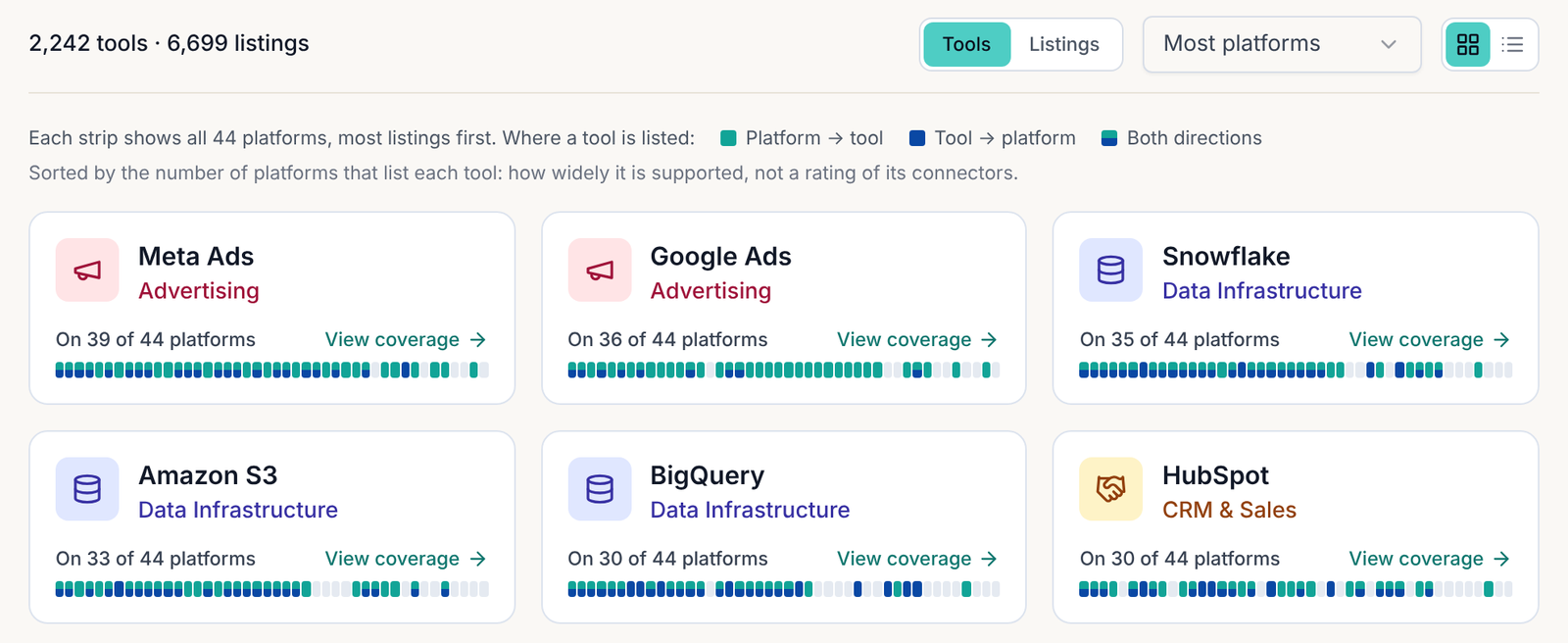
This is the part of "convergence" people underestimate. It isn't that AI bolted a chatbot onto my marketing site. It's that AI changed who is allowed to build software. A founder with deep domain expertise and a structured dataset can now ship the product instead of describing it to someone else. MarTech tooling stopped being something you only buy and became something you can make.
Next, the product grew a face — and a brain
A directory is useful. A directory that talks to you is something else entirely. So I built a virtual avatar — a version of me, "Ed" — to sit on the site and walk visitors through CDP selection the way I would on a call.
The build was a small convergence in its own right. HeyGen handles the part you see and hear: a photoreal, real-time presence that can actually look at you and speak. Anthropic's Claude handles the part you talk to: the reasoning, the product knowledge, the ability to answer a genuine question about whether one platform connects to a given destination. Training it didn't mean training a neural network from scratch — it meant handing a capable model my domain knowledge and a point of view, then wiring it to a face that could deliver them.
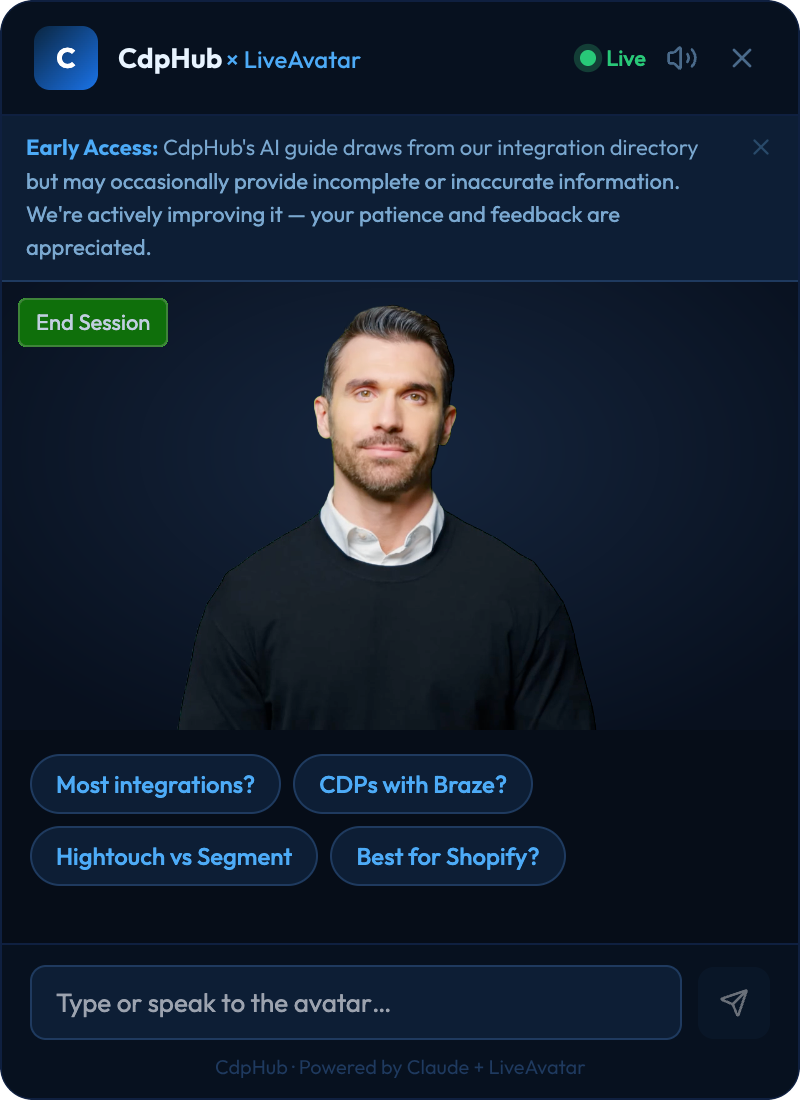
Look closely and that single object is the whole thesis in miniature: the customer-engagement layer (MarTech), the integration knowledge graph (data), and the conversational intelligence (AI) aren't three vendors I duct-taped together. They're one experience.
And then it stopped being about marketing at all
Here's where it gets strange — where the convergence stops being a tidy business story and turns into a personal one.
The same generative toolchain I used to build a talking customer-service avatar is, underneath, character technology. Once you've made one digital human who can move, speak, and emote, the leap to making characters for the screen is far shorter than it should be. That realization became Two Tom Media, the company behind my film projects.
It began, honestly, with love. I'd been making animated "fur baby" portraits — little cinematic pieces built around people's pets. But the ambition grew. I now have several screenplays in active development, and I'm developing and animating characters for one of them: a film about my great-grandfather, Charles Thomas, a passenger aboard the Titanic — a story I'd wanted to tell for years and never had the tools to attempt on my own.


The marketing avatar and the film character are cousins. They come from the same family of technology. The only difference is the story I'm asking them to tell.
The stack collapsed. That's the whole story.
Step back and the path is a single, straight line: structured data → an AI-built product → a conversational digital human → a cinematic character. At no point did I switch disciplines. I switched outputs.
That's what convergence actually feels like from the inside. The walls between data engineering, marketing technology, AI, and creative production didn't disappear, but they got low enough for one person to step over. The Python that catalogs integrations, the AI that helps build interfaces, the models that power an avatar, and the generative pipelines that animate a film are no longer separate stacks for separate people. They're one stack, and increasingly one person can run most of its length.
For marketers, that means the line between buying tools and building them is blurring fast. For founders, it means domain expertise plus AI now reaches further than capital used to. And for anyone with a story to tell — whether it's a product's or a personal one about a man who boarded a ship in 1912 — the distance between having the idea and bringing it to life has never been shorter.
I started with a spreadsheet problem. I ended up developing films. Same toolkit. That isn't a coincidence anymore — it's the new baseline.